Pick up almost any manicure kit and you'll find a flimsy emery board tucked inside. Browse a little longer and someone will tell you a glass file changed their nails for good. Both tools do the same basic job, shaping and smoothing the free edge, but they go about it differently, and that difference shows up most on thin, peely natural nails.
Below we compare the two: what each is made of, what each does best, and which one we'd keep in a drawer at home.
In this guide
Key differences
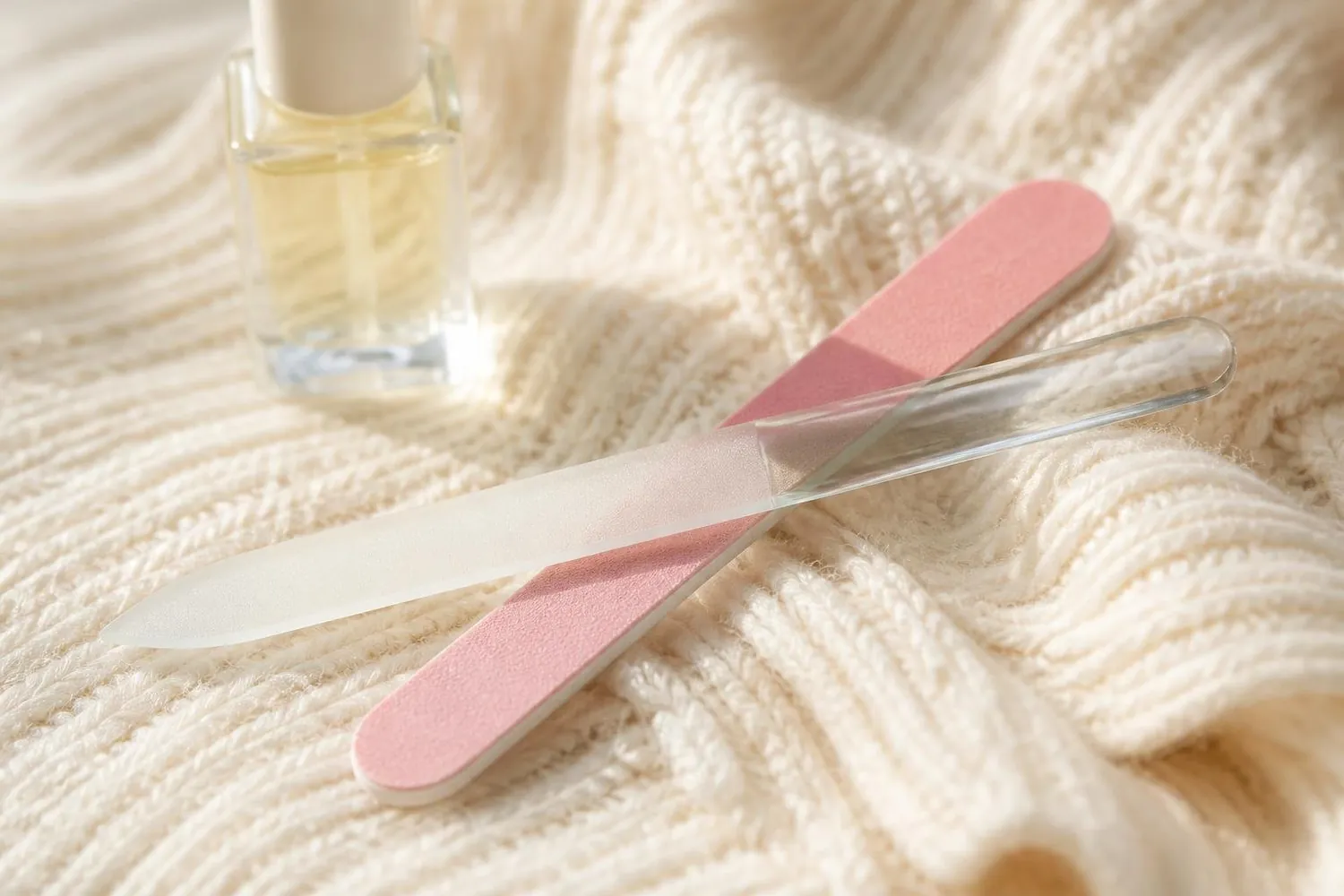
An emery board is a thin core of cardboard, wood or foam with an abrasive grit glued to each side. Traditionally that grit was emery, a dark, naturally gritty rock, though many modern boards use other abrasives. Boards are cheap, light and meant to wear out. Once the surface goes smooth, you toss it.
A glass file (often sold as a crystal or Czech glass file) is a slim pane of tempered glass with a textured filing area. The texture is part of the glass itself rather than a coating, so it doesn't shed grit or fray at the edges in the same way. Because the surface is more even, glass files are widely described as gentler on natural nails, with less of the tearing that can leave a ragged, flaky tip.
The other big difference is how long they last and how you look after them. A glass file can be rinsed with soap and water and dried, then used again and again. An emery board absorbs water and dust, so it's really a short-term tool.
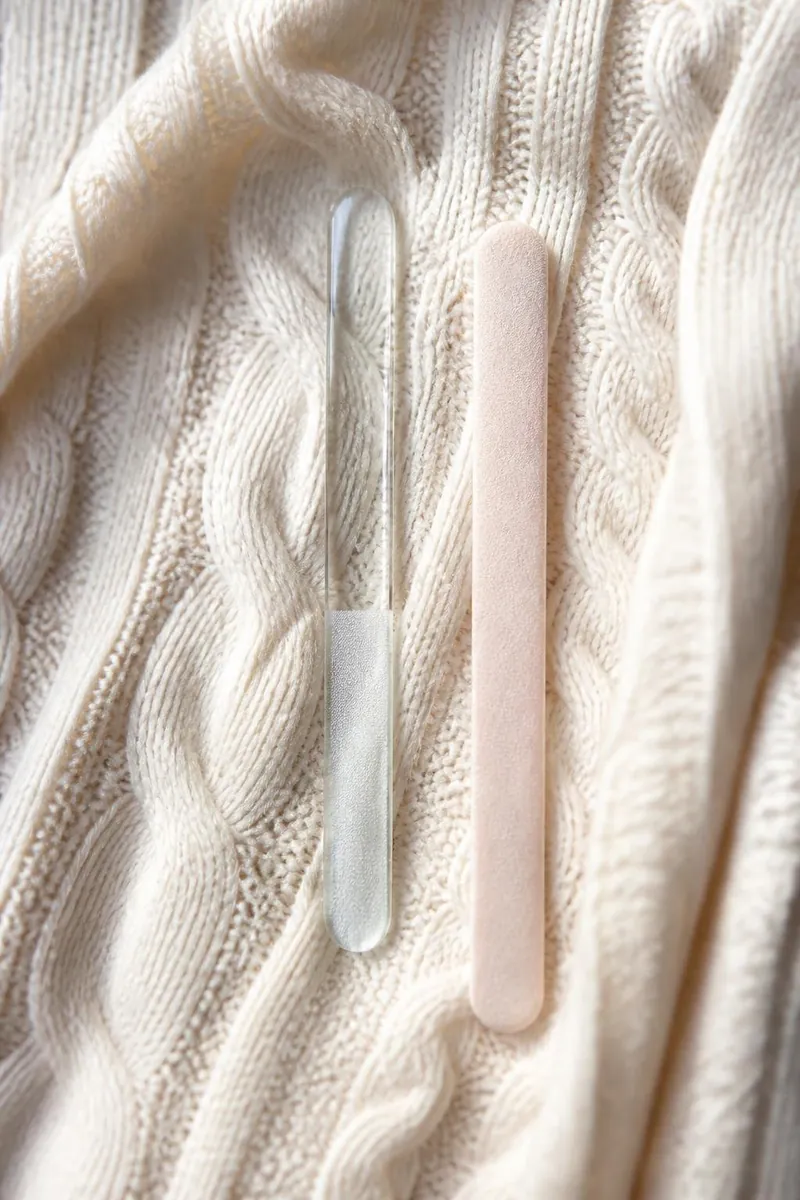
Comparison table
| Glass nail file | Emery board | |
|---|---|---|
| Material | Tempered glass with a textured filing surface | Cardboard, wood or foam core with glued-on abrasive |
| Feel on natural nails | Fine and even; often recommended for thin or peeling nails | Varies by grit; coarser boards can feel harsh on natural nails |
| Best at | Smoothing and refining the free edge | Quick shaping, removing length, working on enhancements (coarser grits) |
| Cleaning | Washable with soap and water | Not really washable; replace when worn or dirty |
| Lifespan | Long-lasting if it isn't dropped | Short; surface wears down with use |
| Portability | Usually comes with a case; can chip or break | Light, flexible, nothing to break |
| Cost over time | Higher upfront, replaced rarely | Very cheap each, replaced often |
| Sharing | Can be cleaned between uses | Best kept to one person |
Understanding grit
Most files and boards carry a grit number. The rule is simple: the lower the number, the coarser the surface. Coarse grits remove material fast and are meant for acrylics and other enhancements. Natural nails do better with finer grits, and many manicurists suggest something in the 180 to 240 range for shaping your own nails. Very high numbers are used for buffing and smoothing rather than shaping.
Glass files don't always list a grit, but their surface tends to sit at the fine end. That's part of why they feel slower than a coarse board. They're doing less damage per stroke, so it takes a few more strokes to shape the edge.
Good to know: The American Academy of Dermatology recommends filing in one direction, since a back-and-forth sawing motion can weaken nails. That advice applies whichever file you choose.
Use cases
When a glass file makes sense
- Your natural nails peel, split or snag easily and you want the gentlest everyday option.
- You're growing your nails out and want a smooth, sealed-feeling edge between manicures.
- You like tools you can wash and keep, rather than buying replacements.
- You keep a polish-free, natural look and care most about a tidy free edge (our no-polish manicure guide pairs well with one).
When an emery board makes sense
- You need to take off real length quickly before refining the shape.
- You're working on acrylics, hard gel or press-ons, where a coarser grit is the right tool.
- You want something to toss in a gym bag, a travel pouch or a desk drawer without worrying about it breaking.
- You're doing a manicure for a friend and want a fresh, single-person tool.
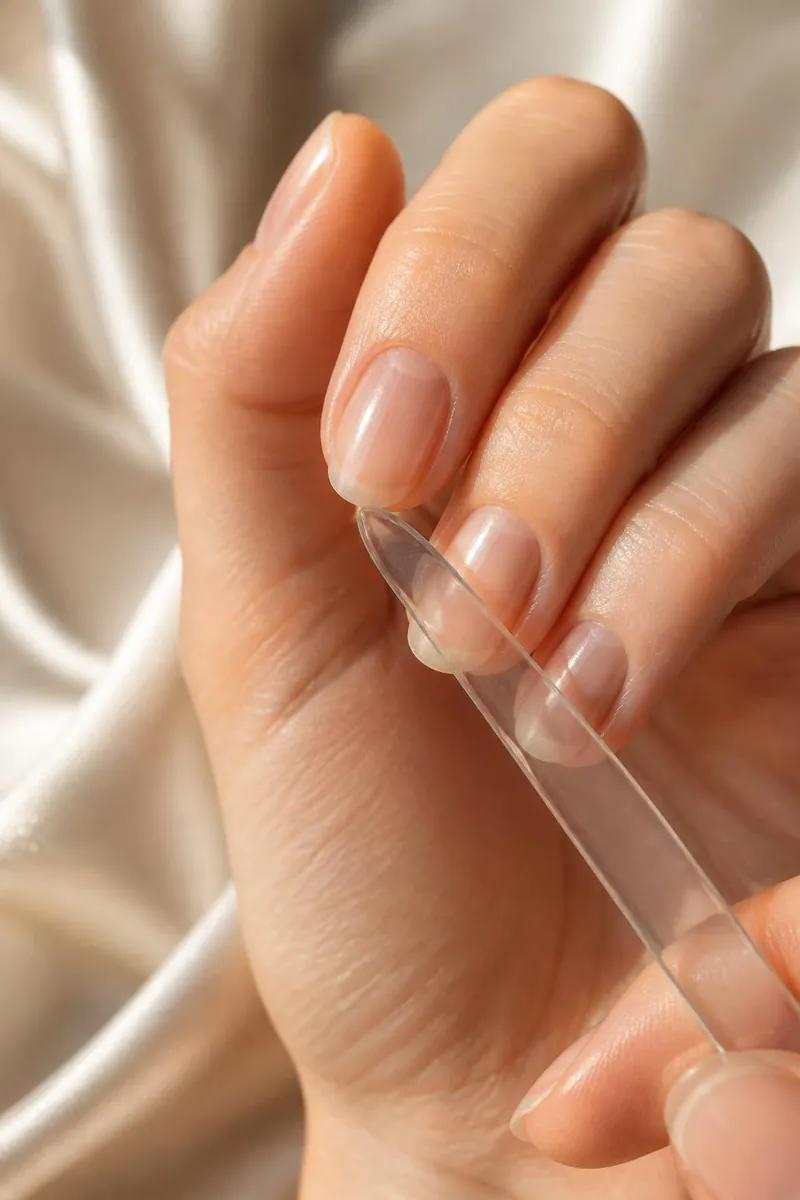
Advantages
Glass file
The main benefit is gentleness. The even, fine surface tends to leave a smooth edge that's less likely to catch on sweaters or tights, which matters if you're trying to stop small snags from turning into breaks. It's also easy to keep clean: a quick wash with soap and warm water, a pat dry, and it's ready. Many people find a single glass file lasts for years, which makes it the more sustainable choice for a lot of households.
They're also nice to own. Glass files are pretty, often tinted or printed, and they come with a slim case that feels nice to keep on a vanity.
Emery board
Boards are flexible, light and practically free, so they're easy to stash everywhere you might need one. They come in a wide range of grits, which means you can buy exactly the coarseness you need for the job in front of you. For shaping long nails or filing enhancements, a board with a coarser side is simply faster. And because they're disposable, there's no maintenance to think about.
Limitations
Glass file
Glass is glass. Drop one on a tile floor and it may chip or snap, so the case is worth using. The fine surface is slow if you're removing a lot of length, and it isn't designed for acrylics or hard gel. Quality also varies: a cheaply made file can have a patchy texture, so it's worth buying from a reputable brand with a clearly described etched surface.
Emery board
The trade-off for low cost is a short life. The grit dulls, the edges soften, and a worn board can drag rather than file. Coarse boards used on thin natural nails can leave a rougher edge that's more prone to peeling. Boards are also hard to clean properly, so they're best treated as personal and replaced regularly.
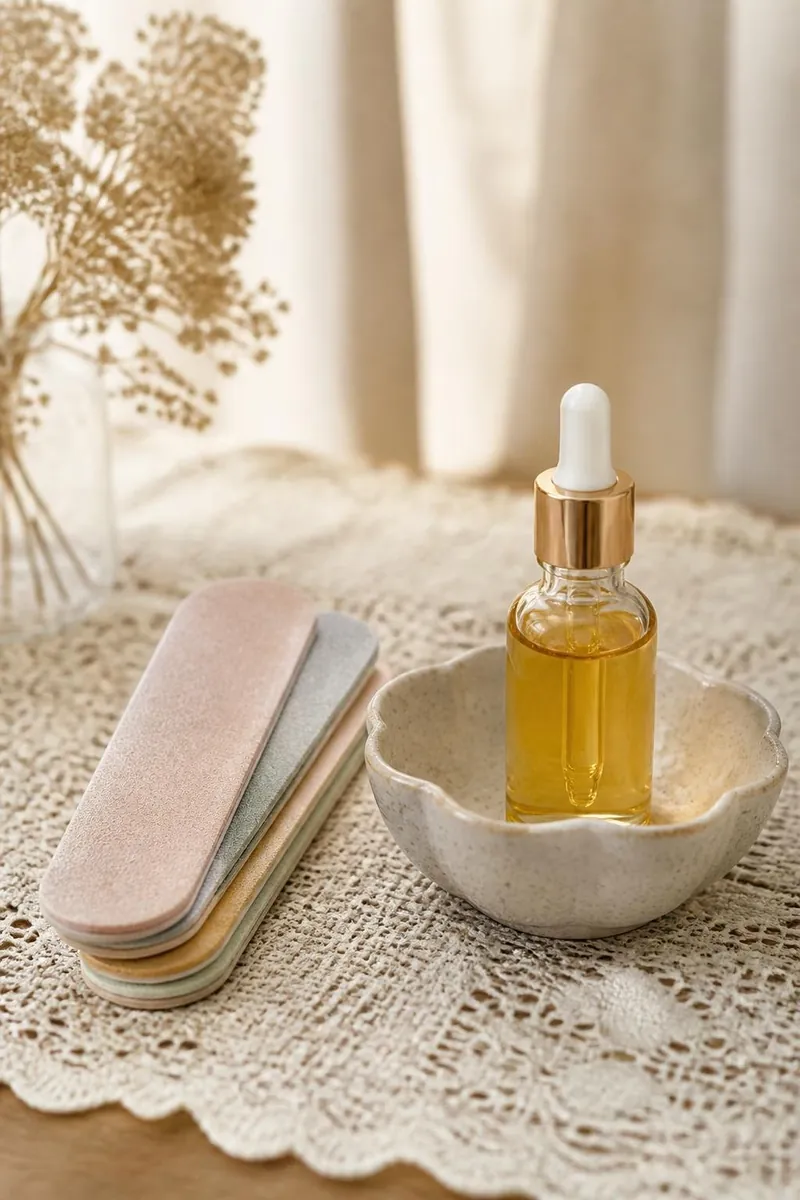
How to file gently with either tool
- Start with clean, dry nails. Filing soft, water-logged nails makes them more likely to bend and tear.
- Hold the file at a slight angle under the free edge rather than straight on top of it.
- Work from the outer corner toward the center in one direction, then repeat on the other side.
- Keep the corners gently rounded so they're less likely to catch.
- Finish with a little cuticle oil along the edge and nail folds (see our cuticle oil guide).
If you want a fuller routine to slot this into, our everyday nail care routine and cuticle care guide walk through the rest.
Final recommendation
For most people with natural nails, a good glass file is the better everyday tool. It's kinder to the free edge, washable and long-lasting, and it encourages the slow, one-direction filing that nails tend to like. Keep an emery board or two on hand for the jobs glass isn't built for: taking off length in a hurry, working on enhancements, or filing on the go without fear of breakage.
A quick word on care: store a glass file in its case, away from the edge of the counter, and wash it whenever it looks dusty. If the filing area ever feels slick rather than gently gritty, it's time for a new one. For emery boards, keep one per person and retire it as soon as the surface stops gripping.
If you only buy one, make it a glass file. If you already own a stack of emery boards, there's no need to throw them out. Just reach for a finer grit, file in one direction, and replace them once they stop feeling crisp.
Products worth a look
GERMANIKURE
GERMANIKURE Crystal Glass Nail File
A glass nail file handcrafted in the Czech Republic from thick Bohemian glass, with a filing surface chemically etched into the glass.…
Researched pickRevlon
Revlon Compact Emery Boards
Classic travel-size, double-sided emery boards. Revlon describes them as strong and flexible, with a coarser side for shaping and a finer side…
Researched pick